> ## Documentation Index
> Fetch the complete documentation index at: https://cubed3-mikhail-cub-3599-rebuild-driver-on-config-change.mintlify.site/llms.txt
> Use this file to discover all available pages before exploring further.
# Set up per-user OAuth
> Configure Cube to authenticate each user with their own OAuth token, falling back to a service account for liveness checks.
This feature is in beta. Reach out to your account manager to have it
enabled for your Cube Cloud deployment.
## Use case
You want each user's queries to run under their own database identity
using OAuth tokens managed by Cube Cloud. When a user's token is
unavailable or expired, Cube falls back to a service account so that
connectivity checks and background operations still work.
This pattern applies to any data source that supports OAuth, including
[Databricks][ref-databricks-jdbc] and [Snowflake][ref-snowflake]. The
examples below use Databricks; switch the `userCredentials` key and
driver options for any other OAuth-capable data source.
Because every user connects with different credentials, you also need
per-user query orchestrator state. Without this, one user's cached
connection could leak to another.
Cube caches one database connection per
[`context_to_orchestrator_id`][ref-context-to-orchestrator-id] for the
lifetime of the process. **Every input your `driver_factory` reads must
therefore also appear in the orchestrator ID.** OAuth access tokens rotate
(typically hourly), so an ID built from the username alone leaves the
cached connection pinned to the token it was first built with — new
database sessions then fail to authenticate until the next deploy. The
configuration below derives both from one helper so they cannot drift.
## Prerequisites
* A [Cube Cloud][ref-cube-cloud] deployment connected to an
OAuth-capable data source
* OAuth configured in your data source so that Cube Cloud can
obtain per-user tokens (via the **User Credentials** feature)
* A service account credential (token or password) stored as an
environment variable for fallback connectivity
The service account credential is used only as a fallback for Cube's
internal liveness checks and background operations. Grant it the minimum
permissions necessary — ideally read-only access to the required schemas —
to limit exposure if the credential is compromised.
## Set up the OAuth app
Before configuring Cube to use per-user OAuth, register your data
source as an OAuth app in Cube Cloud:
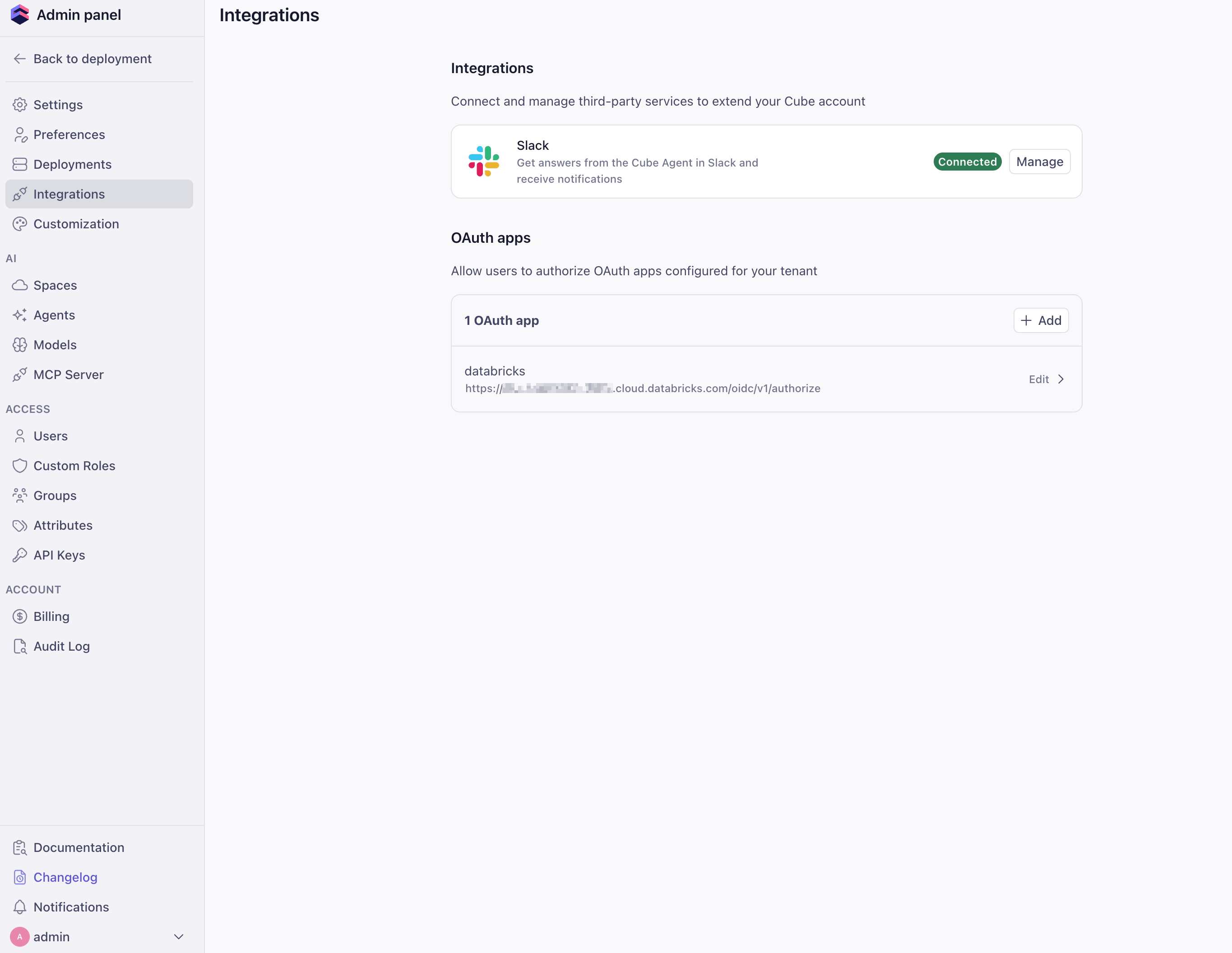
In Cube Cloud, go to **Admin → Integrations → OAuth apps** and click
**Add**.
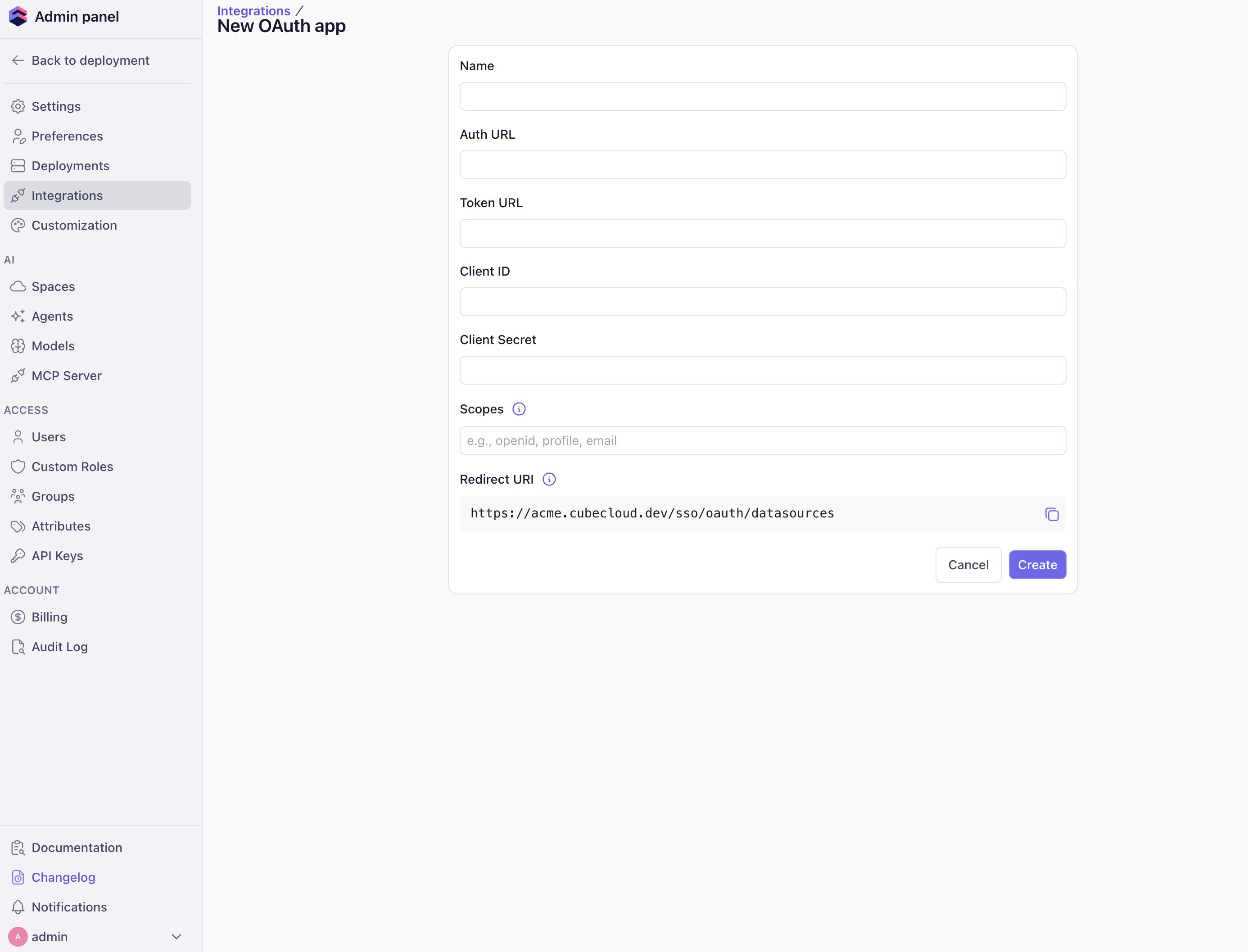
 Provide the OAuth app metadata from your data source: **Name**,
**Auth URL**, **Token URL**, **Client ID**, **Client Secret**, and any
required **Scopes**. Copy the **Redirect URI** shown in this form and
register it with your data source's OAuth provider, then click
**Create**.
Provide the OAuth app metadata from your data source: **Name**,
**Auth URL**, **Token URL**, **Client ID**, **Client Secret**, and any
required **Scopes**. Copy the **Redirect URI** shown in this form and
register it with your data source's OAuth provider, then click
**Create**.
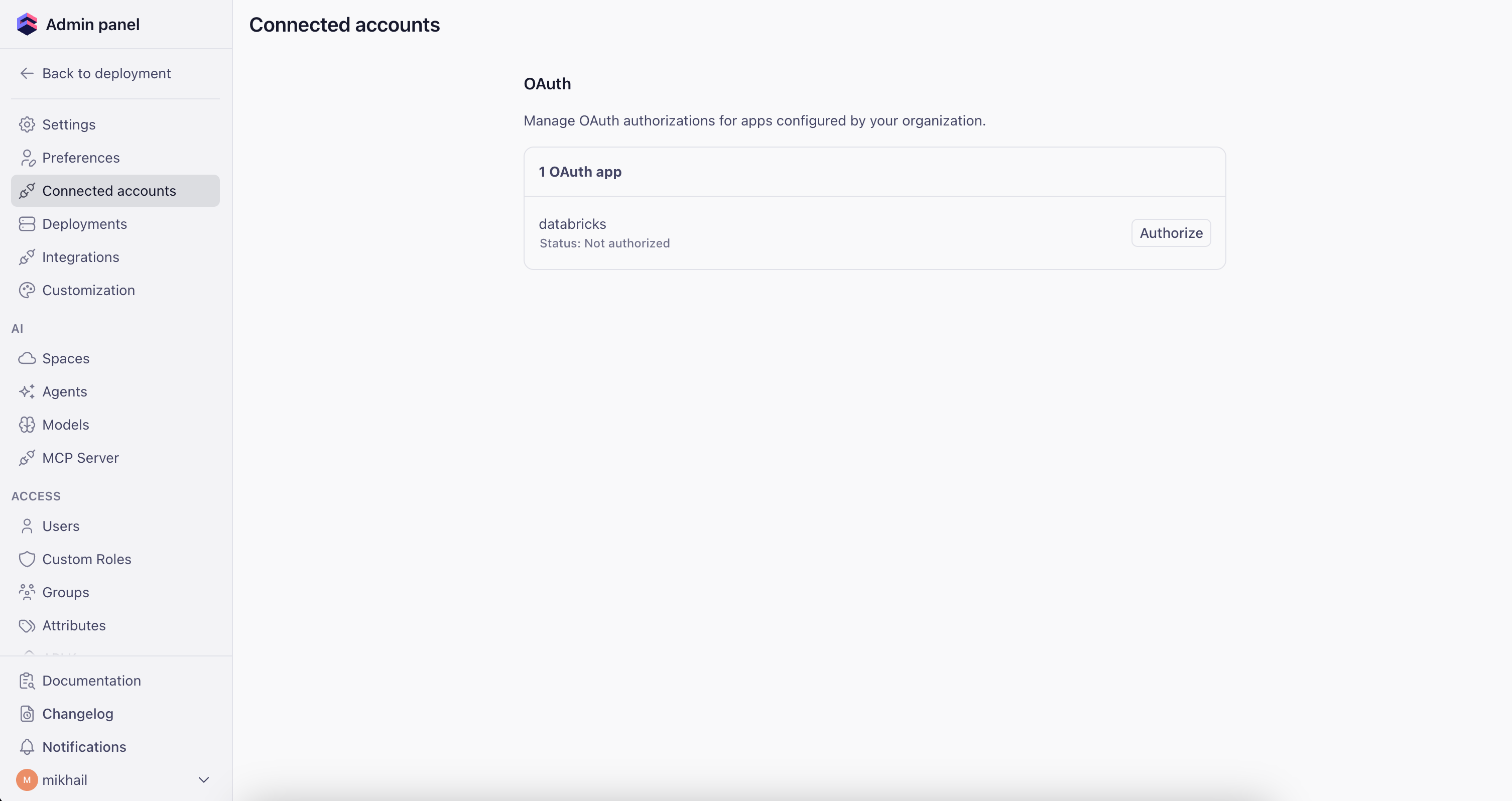
 Open the sidebar and go to **Connected apps**. Find your OAuth app
and click **Authorize** to generate an access token.
You'll need to repeat this step whenever the token expires.
Open the sidebar and go to **Connected apps**. Find your OAuth app
and click **Authorize** to generate an access token.
You'll need to repeat this step whenever the token expires.
 ## Configuration
The configuration uses two options from the
[configuration file reference][ref-config]:
* [`driver_factory`][ref-driver-factory] — dynamically selects the
authentication credential per request
* [`context_to_orchestrator_id`][ref-context-to-orchestrator-id] — gives
each user their own query orchestrator instance (database connections,
execution queues, pre-aggregation table caches)
### Environment variables
Set the environment variables for your data source. The examples below
show Databricks and Snowflake; adapt them to your specific setup.
```dotenv theme={null}
CUBEJS_DB_TYPE=databricks-jdbc
CUBEJS_DB_DATABRICKS_URL=jdbc:databricks://dbc-XXXXXXX-XXXX.cloud.databricks.com:443/default;transportMode=http;ssl=1;httpPath=sql/protocolv1/o/XXXXX/XXXXX;AuthMech=3;UID=token
CUBEJS_DB_DATABRICKS_TOKEN=dapi_service_account_token
CUBEJS_DB_DATABRICKS_ACCEPT_POLICY=true
# Optional: specify a catalog
CUBEJS_DB_DATABRICKS_CATALOG=my_catalog
```
```dotenv theme={null}
CUBEJS_DB_TYPE=snowflake
CUBEJS_DB_SNOWFLAKE_ACCOUNT=XXXXXXXXX.us-east-1
CUBEJS_DB_SNOWFLAKE_WAREHOUSE=MY_SNOWFLAKE_WAREHOUSE
CUBEJS_DB_NAME=my_snowflake_database
CUBEJS_DB_USER=service_account_user
CUBEJS_DB_PASS=service_account_password
CUBEJS_DB_SNOWFLAKE_ROLE=MY_ROLE
```
### Configuration file
The examples below use Databricks. To target a different data source,
swap `userCredentials.databricks` for the matching key (for example,
`userCredentials.snowflake`) and update the `driver_factory` return
value with the correct `type` and driver-specific options. See the
[data sources reference][ref-data-sources] for available drivers.
```python cube.py theme={null}
from cube import config
from datetime import datetime, timezone
import os
import time
# Don't hand the driver a token that is about to expire. Drivers cache their
# connection settings, and the connection pool opens new sessions long after
# the driver was built, so "valid right now" is not enough.
EXPIRY_SKEW_SECONDS = 120
def _parse_expiry(value):
if not value:
return None
try:
parsed = datetime.fromisoformat(str(value).replace("Z", "+00:00"))
except ValueError:
return None
if parsed.tzinfo is None:
parsed = parsed.replace(tzinfo=timezone.utc)
return parsed.timestamp()
def _credential(ctx: dict):
"""Resolve the credential for this request, plus the key identifying it.
driver_factory and context_to_orchestrator_id both call this, so the cached
connection can never drift from the token it was built with.
"""
# For other data sources, swap "databricks" for "snowflake", etc.
cube_cloud = (ctx.get("securityContext") or {}).get("cubeCloud") or {}
creds = (cube_cloud.get("userCredentials") or {}).get("databricks") or {}
access_token = creds.get("accessToken")
expires_at = _parse_expiry(creds.get("accessTokenExpiresAt"))
# Gate on the expiry rather than on `status`: a failed background refresh
# can flag the record while the token already in hand is still valid, and
# treating that as fatal drops the user onto the service account for no
# reason.
if access_token and expires_at and expires_at > time.time() + EXPIRY_SKEW_SECONDS:
# Key on the expiry, never on the token itself — the orchestrator ID is
# used as a cache prefix and appears in logs.
return access_token, f"u{int(expires_at)}"
return os.environ["CUBEJS_DB_DATABRICKS_TOKEN"], "service-account"
@config("driver_factory")
def driver_factory(ctx: dict) -> dict:
token, _ = _credential(ctx)
return {
"type": "databricks-jdbc",
"url": os.environ["CUBEJS_DB_DATABRICKS_URL"],
"token": token,
"acceptPolicy": True,
"catalog": os.environ.get("CUBEJS_DB_DATABRICKS_CATALOG"),
}
@config("context_to_orchestrator_id")
def context_to_orchestrator_id(ctx: dict) -> str:
# One orchestrator per (user, credential): separate DB connections,
# execution queues and pre-aggregation caches, and a cache key that changes
# when the token rotates.
cube_cloud = (ctx.get("securityContext") or {}).get("cubeCloud") or {}
username = cube_cloud.get("username") or "default"
_, cache_key = _credential(ctx)
return f"CUBE_APP_{username}_{cache_key}"
```
```javascript cube.js theme={null}
// Don't hand the driver a token that is about to expire. Drivers cache their
// connection settings, and the connection pool opens new sessions long after
// the driver was built, so "valid right now" is not enough.
const EXPIRY_SKEW_MS = 120 * 1000;
/**
* Resolve the credential for this request, plus the key identifying it.
*
* driverFactory and contextToOrchestratorId both call this, so the cached
* connection can never drift from the token it was built with.
*/
function resolveCredential(securityContext) {
// For other data sources, swap `databricks` for `snowflake`, etc.
const creds = securityContext?.cubeCloud?.userCredentials?.databricks ?? {};
const expiresAt = Date.parse(creds.accessTokenExpiresAt ?? "");
// Gate on the expiry rather than on `status`: a failed background refresh can
// flag the record while the token already in hand is still valid, and
// treating that as fatal drops the user onto the service account for no
// reason.
if (creds.accessToken && expiresAt > Date.now() + EXPIRY_SKEW_MS) {
// Key on the expiry, never on the token itself — the orchestrator ID is
// used as a cache prefix and appears in logs.
return { token: creds.accessToken, cacheKey: `u${expiresAt}` };
}
return {
token: process.env.CUBEJS_DB_DATABRICKS_TOKEN,
cacheKey: "service-account",
};
}
module.exports = {
driverFactory: ({ securityContext }) => ({
type: "databricks-jdbc",
url: process.env.CUBEJS_DB_DATABRICKS_URL,
token: resolveCredential(securityContext).token,
acceptPolicy: true,
catalog: process.env.CUBEJS_DB_DATABRICKS_CATALOG,
}),
// One orchestrator per (user, credential): separate DB connections, execution
// queues and pre-aggregation caches, and a cache key that changes when the
// token rotates.
contextToOrchestratorId: ({ securityContext }) => {
const username = securityContext?.cubeCloud?.username ?? "default";
const { cacheKey } = resolveCredential(securityContext);
return `CUBE_APP_${username}_${cacheKey}`;
},
};
```
## How it works
1. **User makes a request** — Cube Cloud attaches the user's OAuth
credentials to `securityContext.cubeCloud.userCredentials.`
(for example, `.databricks` or `.snowflake`).
2. **`driver_factory` resolves the credential** — If the user has a token
that has not expired, it is used. Otherwise, Cube falls back to the
service account credential stored in environment variables.
3. **Per-user, per-credential orchestrator** —
[`context_to_orchestrator_id`][ref-context-to-orchestrator-id] returns a
key derived from both the username and the credential in use, so each
user gets their own database connection pool, execution queues, and
pre-aggregation table cache — and a rotated token produces a fresh
connection instead of reusing one built from the previous token. Keying
on the username alone would share a single cached connection across
token rotations; omitting the username would share one across users.
## Operational notes
* **Expect one orchestrator per token rotation.** Each distinct
orchestrator ID holds its own connection pool, queues and
pre-aggregation table cache, and tokens typically rotate hourly. Watch
memory on deployments with many concurrent users, and note that the
first query after a rotation runs against a cold pre-aggregation cache.
* **Don't make [`context_to_app_id`][ref-context-to-appid] per-user.** The
data model is identical for every user — only the connection differs —
so a per-user app ID forces a full data-model recompile per user on
every replica for no benefit. Leave it unset, or return a constant if
your deployment already sets one.
* **Give the service account the minimum it needs to pass a connection
check.** If it has no access at all, liveness checks and any query that
falls back to it fail with an opaque authorization error from the driver
rather than something diagnosable.
[ref-config]: /reference/configuration/config
[ref-driver-factory]: /reference/configuration/config#driver_factory
[ref-context-to-orchestrator-id]: /reference/configuration/config#context_to_orchestrator_id
[ref-context-to-appid]: /reference/configuration/config#context_to_app_id
[ref-databricks-jdbc]: /admin/connect-to-data/data-sources/databricks-jdbc
[ref-snowflake]: /admin/connect-to-data/data-sources/snowflake
[ref-data-sources]: /admin/connect-to-data/data-sources
[ref-cube-cloud]: /docs/introduction
## Configuration
The configuration uses two options from the
[configuration file reference][ref-config]:
* [`driver_factory`][ref-driver-factory] — dynamically selects the
authentication credential per request
* [`context_to_orchestrator_id`][ref-context-to-orchestrator-id] — gives
each user their own query orchestrator instance (database connections,
execution queues, pre-aggregation table caches)
### Environment variables
Set the environment variables for your data source. The examples below
show Databricks and Snowflake; adapt them to your specific setup.
```dotenv theme={null}
CUBEJS_DB_TYPE=databricks-jdbc
CUBEJS_DB_DATABRICKS_URL=jdbc:databricks://dbc-XXXXXXX-XXXX.cloud.databricks.com:443/default;transportMode=http;ssl=1;httpPath=sql/protocolv1/o/XXXXX/XXXXX;AuthMech=3;UID=token
CUBEJS_DB_DATABRICKS_TOKEN=dapi_service_account_token
CUBEJS_DB_DATABRICKS_ACCEPT_POLICY=true
# Optional: specify a catalog
CUBEJS_DB_DATABRICKS_CATALOG=my_catalog
```
```dotenv theme={null}
CUBEJS_DB_TYPE=snowflake
CUBEJS_DB_SNOWFLAKE_ACCOUNT=XXXXXXXXX.us-east-1
CUBEJS_DB_SNOWFLAKE_WAREHOUSE=MY_SNOWFLAKE_WAREHOUSE
CUBEJS_DB_NAME=my_snowflake_database
CUBEJS_DB_USER=service_account_user
CUBEJS_DB_PASS=service_account_password
CUBEJS_DB_SNOWFLAKE_ROLE=MY_ROLE
```
### Configuration file
The examples below use Databricks. To target a different data source,
swap `userCredentials.databricks` for the matching key (for example,
`userCredentials.snowflake`) and update the `driver_factory` return
value with the correct `type` and driver-specific options. See the
[data sources reference][ref-data-sources] for available drivers.
```python cube.py theme={null}
from cube import config
from datetime import datetime, timezone
import os
import time
# Don't hand the driver a token that is about to expire. Drivers cache their
# connection settings, and the connection pool opens new sessions long after
# the driver was built, so "valid right now" is not enough.
EXPIRY_SKEW_SECONDS = 120
def _parse_expiry(value):
if not value:
return None
try:
parsed = datetime.fromisoformat(str(value).replace("Z", "+00:00"))
except ValueError:
return None
if parsed.tzinfo is None:
parsed = parsed.replace(tzinfo=timezone.utc)
return parsed.timestamp()
def _credential(ctx: dict):
"""Resolve the credential for this request, plus the key identifying it.
driver_factory and context_to_orchestrator_id both call this, so the cached
connection can never drift from the token it was built with.
"""
# For other data sources, swap "databricks" for "snowflake", etc.
cube_cloud = (ctx.get("securityContext") or {}).get("cubeCloud") or {}
creds = (cube_cloud.get("userCredentials") or {}).get("databricks") or {}
access_token = creds.get("accessToken")
expires_at = _parse_expiry(creds.get("accessTokenExpiresAt"))
# Gate on the expiry rather than on `status`: a failed background refresh
# can flag the record while the token already in hand is still valid, and
# treating that as fatal drops the user onto the service account for no
# reason.
if access_token and expires_at and expires_at > time.time() + EXPIRY_SKEW_SECONDS:
# Key on the expiry, never on the token itself — the orchestrator ID is
# used as a cache prefix and appears in logs.
return access_token, f"u{int(expires_at)}"
return os.environ["CUBEJS_DB_DATABRICKS_TOKEN"], "service-account"
@config("driver_factory")
def driver_factory(ctx: dict) -> dict:
token, _ = _credential(ctx)
return {
"type": "databricks-jdbc",
"url": os.environ["CUBEJS_DB_DATABRICKS_URL"],
"token": token,
"acceptPolicy": True,
"catalog": os.environ.get("CUBEJS_DB_DATABRICKS_CATALOG"),
}
@config("context_to_orchestrator_id")
def context_to_orchestrator_id(ctx: dict) -> str:
# One orchestrator per (user, credential): separate DB connections,
# execution queues and pre-aggregation caches, and a cache key that changes
# when the token rotates.
cube_cloud = (ctx.get("securityContext") or {}).get("cubeCloud") or {}
username = cube_cloud.get("username") or "default"
_, cache_key = _credential(ctx)
return f"CUBE_APP_{username}_{cache_key}"
```
```javascript cube.js theme={null}
// Don't hand the driver a token that is about to expire. Drivers cache their
// connection settings, and the connection pool opens new sessions long after
// the driver was built, so "valid right now" is not enough.
const EXPIRY_SKEW_MS = 120 * 1000;
/**
* Resolve the credential for this request, plus the key identifying it.
*
* driverFactory and contextToOrchestratorId both call this, so the cached
* connection can never drift from the token it was built with.
*/
function resolveCredential(securityContext) {
// For other data sources, swap `databricks` for `snowflake`, etc.
const creds = securityContext?.cubeCloud?.userCredentials?.databricks ?? {};
const expiresAt = Date.parse(creds.accessTokenExpiresAt ?? "");
// Gate on the expiry rather than on `status`: a failed background refresh can
// flag the record while the token already in hand is still valid, and
// treating that as fatal drops the user onto the service account for no
// reason.
if (creds.accessToken && expiresAt > Date.now() + EXPIRY_SKEW_MS) {
// Key on the expiry, never on the token itself — the orchestrator ID is
// used as a cache prefix and appears in logs.
return { token: creds.accessToken, cacheKey: `u${expiresAt}` };
}
return {
token: process.env.CUBEJS_DB_DATABRICKS_TOKEN,
cacheKey: "service-account",
};
}
module.exports = {
driverFactory: ({ securityContext }) => ({
type: "databricks-jdbc",
url: process.env.CUBEJS_DB_DATABRICKS_URL,
token: resolveCredential(securityContext).token,
acceptPolicy: true,
catalog: process.env.CUBEJS_DB_DATABRICKS_CATALOG,
}),
// One orchestrator per (user, credential): separate DB connections, execution
// queues and pre-aggregation caches, and a cache key that changes when the
// token rotates.
contextToOrchestratorId: ({ securityContext }) => {
const username = securityContext?.cubeCloud?.username ?? "default";
const { cacheKey } = resolveCredential(securityContext);
return `CUBE_APP_${username}_${cacheKey}`;
},
};
```
## How it works
1. **User makes a request** — Cube Cloud attaches the user's OAuth
credentials to `securityContext.cubeCloud.userCredentials.`
(for example, `.databricks` or `.snowflake`).
2. **`driver_factory` resolves the credential** — If the user has a token
that has not expired, it is used. Otherwise, Cube falls back to the
service account credential stored in environment variables.
3. **Per-user, per-credential orchestrator** —
[`context_to_orchestrator_id`][ref-context-to-orchestrator-id] returns a
key derived from both the username and the credential in use, so each
user gets their own database connection pool, execution queues, and
pre-aggregation table cache — and a rotated token produces a fresh
connection instead of reusing one built from the previous token. Keying
on the username alone would share a single cached connection across
token rotations; omitting the username would share one across users.
## Operational notes
* **Expect one orchestrator per token rotation.** Each distinct
orchestrator ID holds its own connection pool, queues and
pre-aggregation table cache, and tokens typically rotate hourly. Watch
memory on deployments with many concurrent users, and note that the
first query after a rotation runs against a cold pre-aggregation cache.
* **Don't make [`context_to_app_id`][ref-context-to-appid] per-user.** The
data model is identical for every user — only the connection differs —
so a per-user app ID forces a full data-model recompile per user on
every replica for no benefit. Leave it unset, or return a constant if
your deployment already sets one.
* **Give the service account the minimum it needs to pass a connection
check.** If it has no access at all, liveness checks and any query that
falls back to it fail with an opaque authorization error from the driver
rather than something diagnosable.
[ref-config]: /reference/configuration/config
[ref-driver-factory]: /reference/configuration/config#driver_factory
[ref-context-to-orchestrator-id]: /reference/configuration/config#context_to_orchestrator_id
[ref-context-to-appid]: /reference/configuration/config#context_to_app_id
[ref-databricks-jdbc]: /admin/connect-to-data/data-sources/databricks-jdbc
[ref-snowflake]: /admin/connect-to-data/data-sources/snowflake
[ref-data-sources]: /admin/connect-to-data/data-sources
[ref-cube-cloud]: /docs/introduction